“In the course of our development and cultivation, we have ultimately attained a human body — through which we are able to feel, connect with, and receive the manifold, diverse energies of Yin, Yang, Wind, Clouds, Rain, the Clearing, Sky, Sun, Moon, the Radiance, the Reflection, the Luminosity, Awareness, the Stream, the Rapids, the beautifully swirling Current, Clarity and deep Stillness.”
— from the Song of Wu Ji Quan, Grandmaster Chee Kim Thong, transmitted directly to Dr. Ortwin Lüers, 1992, Kuala Lumpur (Chee Kim Thong Pugilistic & Health Society, Malaysia)
At the very heart of Wu Ji Quan lies something far older than philosophy: the primal necessity of being alive in nature. Long before any conscious practice, human beings stood in sunlight, felt the wind, breathed the rain-washed air — not as an exercise, but because this was life itself. They had no choice but to be fully present. Their survival depended on it.
And it was never a solitary endeavour. These earliest humans faced nature together — as a tribe, a community bound by shared necessity. The we came before the I. Warmth was shared, knowledge passed from body to body through movement and ritual. What we now call Wu Ji Quan carries this collective memory in its deepest roots: a shared art of living, enduring, and thriving within the web of nature.
Receiving What Nature Freely Gives
The sun is the primary source of all life force on Earth. Wu Ji Quan is a practice of conscious reception — opening the body, the meridians, the fasciae and tendons, to absorb what nature offers in abundance: sunlight, fresh air, the pulse of the earth beneath the feet. The movement forms are not merely exercise. They are a tuning of the human instrument to the frequencies of the living world.
The most natural entry into this practice is gratitude — not as a mental attitude, but as a felt, bodily experience. Where modern life closes us off from weather and season, Wu Ji Quan turns us gently back toward the source.
Gravity and Space — Yin and Yang and the Great Dao
Among the qualities I particularly wish to highlight is the conscious, playful relationship with the two most primal forces of physical existence — gravity and space. These are not merely biomechanical realities. They are the physical embodiment of Yin and Yang: gravity as Yin, the downward drawing and yielding return to Earth; space as Yang, the opening, rising, expanding potential. Together they are the breath of the Dao moving through the body and the universe simultaneously.
At the heart of this lies the most universal principle in nature: sinking and rising. What descends nourishes the roots; what rises reaches toward light. In Wu Ji Quan these are not techniques to be learned but natural laws to be remembered — felt in every breath, every transfer of weight. To sink is to let the Earth receive the body; to rise is to let the sky draw it upward. Between these two movements, effortlessly balanced, Chi flows freely.
What sets Wu Ji Quan apart from other related arts — and what I consider its most important distinguishing feature — is how these qualities bridge all three dimensions of the art simultaneously: martial art, healing, and foundational spirituality. Although refined within the Buddhist Shaolin tradition, Wu Ji Quan is in its essence completely free of any worldview or belief system. It requires no faith, no doctrine — only presence, breath, and openness to the forces of nature. As Grandmaster Chee Kim Thong repeatedly emphasised: a human practice, available to all, regardless of their path.
Chi — Life Force in Flow
The 18 forms of Wu Ji Quan and the 12 Steps Qi Gong — written in the hand of Grandmaster Chee Kim Thong himself — follow the same source and the same foundational idea: the primordial human experience of belonging to nature, the reception of elemental forces, the flow of life energy through a body that has learned to remain open. Both are expressions of the same transmitted wisdom — different in form, one in their origin.
The practitioner does not take energy — they open to it. The sun feeds Chi. Stillness in nature restores it. Conscious movement circulates it. Community amplifies it.
Wu Ji Quan as Ritual — Energising Spaces
The first two forms — Yin and Yang — practiced in all four directions become a moving Feng Shui: a deliberate act of harmonising the energetic quality of a place. Whether in a room, a house, or a garden, the practitioner invites fresh Chi to enter and stagnant energy to clear. Just as acupuncture works on the meridians of the body, Wu Ji Quan practiced as ritual works on the meridians of a place. This is living Feng Shui: not an arrangement of objects, but a practice of presence, breath and moving Chi.
The Wound and the Medicine
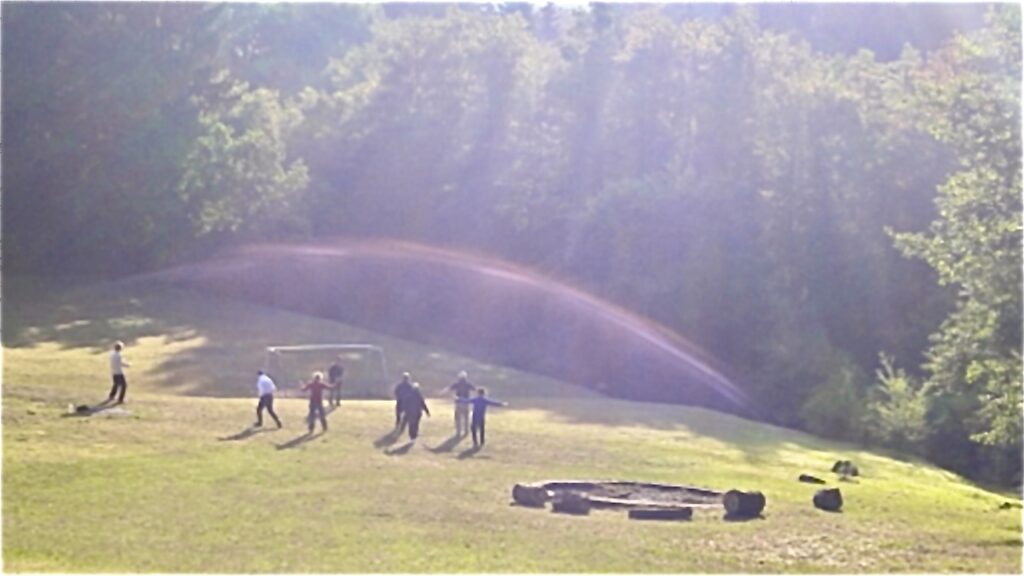
One of the deepest challenges of our time is the numbing — the gradual deadening of our felt sense of belonging to the living world. Wu Ji Quan, practiced in morning light, in wind and weather, is a gentle antidote. When Chi flows — when the warmth of the sun is truly absorbed, when the breath deepens and the body softens into its own aliveness — the numbness lifts.
This is what Grandmaster Chee Kim Thong carried forward from the oldest human wisdom: life force is not manufactured inside us. It is received — from sun, from earth, from sky, from the community of all living beings and can be cultivated for fertility, regeneration and internal growth.
We are nature — and when we return to nature, we come alive again.
Simply standing in morning sunlight, turning toward the warmth, breathing it in — this is already Wu Ji Quan.